
Norristown City Directory Holdings
Norristown does not have one confirmed, complete online city-directory run for every year. The verified material is more useful when it is treated as a set of dated collections. The strongest online item is the 1860-61 directory of Norristown and Bridgeport. HSMC also cites a Norristown Directory run from 1859 through 1925 in its 1970 bibliography, along with later examples used in its local-history writing. A citation to a run is a lead to check, not proof that every volume is digitized, complete, or available without an appointment.
| Collection | Years | Where Held | Access |
|---|---|---|---|
| Directory of the Boroughs of Norristown and Bridgeport | 1860-61 | Penn State Libraries digital collection | Browse the original online |
| Norristown Directory run cited by HSMC | 1859-1925 | HSMC reference and archives | Confirm the needed volume first |
| HSMC city and business-directory examples | 1890; 1908-31; 1936; 1951 | HSMC collection references | Use the year and entry cited by the source |
| Times Herald obituary index | 1919-20; 1921-22; 1923-24 | Historical Society of Montgomery County | Request a copy with name, paper, and date |
The list distinguishes a directory from companion evidence. An obituary index can help date a family event, while a directory supplies a period entry. Neither replaces the other. When a year is missing from an online search, ask HSMC whether a physical volume, microfilm, research file, or related newspaper source is available before drawing a conclusion from the gap.
Note: An unlisted year can mean no accessible volume was confirmed, not that no Norristown household or firm existed that year.
The 1860-61 Norristown City Directory
The digitized Directory of the Boroughs of Norristown and Bridgeport, Montgomery County, Pa., 1860-61 is a primary-period source. Penn State identifies Williams Whitehead with the directory and E. F. James Steam Power Press of West Chester with its imprint. That provenance makes the volume useful for a narrow 1860-61 question, such as the spelling of an entry or an address as the book printed it. It does not establish where someone lived before or after that stated period.
Penn State Libraries' digitized 1860-61 Norristown and Bridgeport directory is the source for the image below.
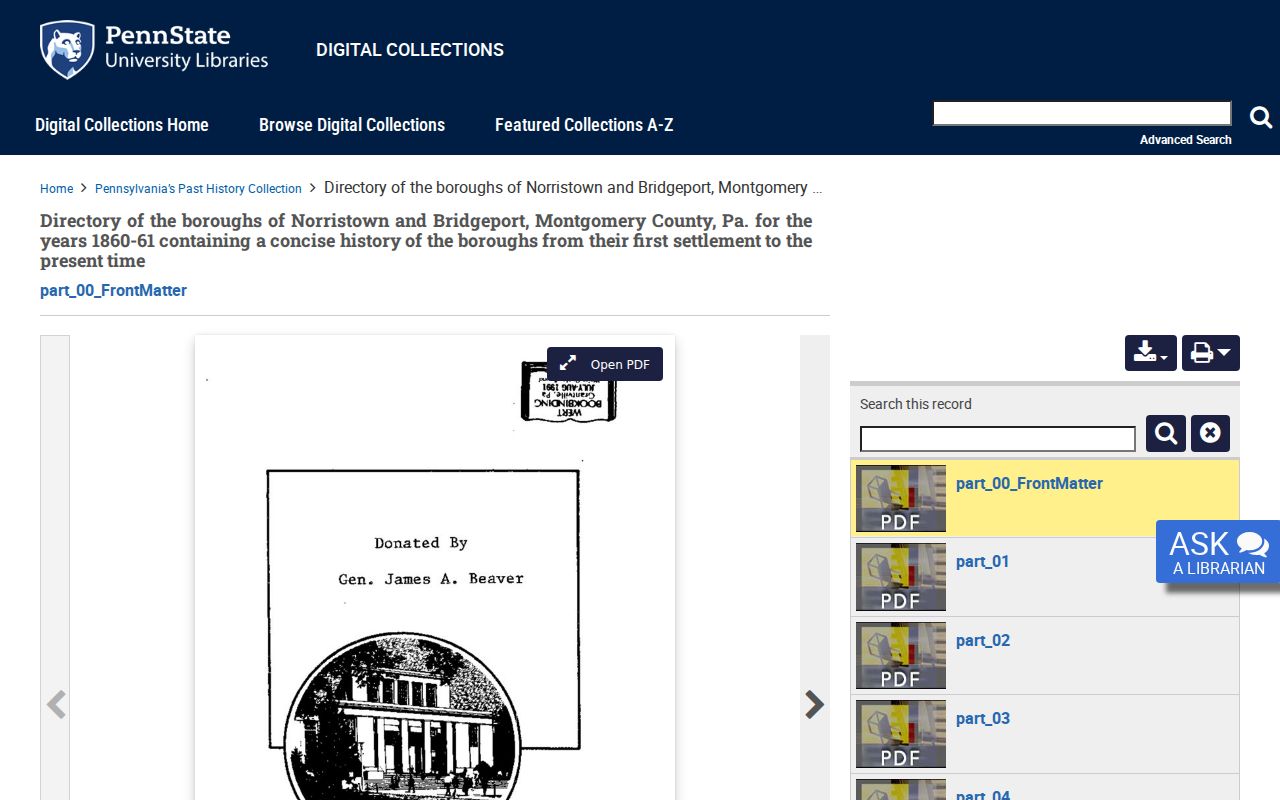
Use the original digital item to keep a page or image reference with each Norristown directory finding. That record of where the wording came from is more reliable than a copied name alone.
HSMC's Norristown Directory Shelves
The Historical Society of Montgomery County Archives & Library is the principal local stop for a Norristown historical-directory search that cannot be finished online. It is at 1654 DeKalb Street in Norristown. HSMC lists genealogical materials, family histories, religious records, county and town history, county-tax-record microfilm, and Norristown Times Herald microfilm among its key collections. Its research library is available during regular hours, while archive material should be arranged ahead so staff can pull it.
HSMC lists Monday, Tuesday, and Thursday hours of 10 a.m. to 5 p.m.; Wednesday from 1 p.m. to 8 p.m.; and the first Saturday from 10 a.m. to 2 p.m. It also lists a $30-per-hour staff-research service, $7 daily use for nonmembers, and ordinary copy charges of $0.50 for nonmembers and $0.25 for members. Those access details can change, so confirm them directly before a visit or request. Bring the directory year, surname spelling, street form, and any page clue already found.
Norristown Directory Newspaper Trails
HSMC's newspaper indexes add a second dated layer when a Norristown directory entry needs family context. Its published Times Herald obituary-index ranges are 1919-20, 1921-22, and 1923-24. HSMC says a copy request needs the decedent's name, newspaper, and date, and lists a $5 charge. The source can supply a chronology lead, not a full address history.
The Society's digital-newspapers resources identify the Olive Branch for 1851-57 and the National Defender for 1856-1900. Preserve the publication date, page or item reference, and exact relationship wording. A notice may support a period association, but it should be compared with a directory, civic record, or census before it is used to connect a person to a Norristown address.
Note: A newspaper notice is a dated lead, so its date and wording should remain attached to every Norristown directory citation.
Reading a Norristown City Directory
A dated Norristown directory entry is safest when read as a small piece of printed evidence. The research confirms that the local collection can supply period names, street-address-era clues, and, in cited HSMC examples, business or directory context. It does not support a universal claim that every local volume has the same layout or that a particular shorthand carries the same meaning from year to year. Start with what is actually visible in the cited item.
| Printed name or firm | Record the spelling exactly as the Norristown volume shows it. |
|---|---|
| Printed street address | Use it as a date-specific address clue, not proof of an unbroken residence. |
| Directory context | Keep any visible category with the entry rather than expanding its meaning. |
| Volume date | State the year or period printed by the directory. |
| Page or image reference | Keep the location needed to return to the original entry. |
| Uncaptured details | The research did not preserve a local entry image or abbreviation key, so unverified field readings are omitted. |
That restraint matters with a common surname. A printed name can be a strong starting point, but a compatible address, date, instrument number, or documented family relationship is needed before two records are treated as the same person.
Norristown Directory Terms Defined
Older collection labels can make a Norristown historical-directory search sound more certain than it is. HSMC's bibliography and articles establish valuable directory leads, but this research did not verify a comprehensive later reverse or street-by-street directory for Norristown. Use the terms below as descriptions of a volume only after the individual item confirms that it contains the stated section or key.
- City directory
- A dated printed directory that may list people, firms, or addresses in the form chosen by that volume.
- Criss-cross directory
- A directory section arranged by street or address rather than by name, when a particular volume actually includes one.
- Householder index
- A name-oriented finding aid associated with household entries, if the cited collection supplies it.
- Abbreviation key
- A printed explanation of shorthand used in that volume. No local key should be assumed without seeing it.
Take a photo or note of the title page and any visible key before interpreting a line. A volume's own arrangement is the authority for that volume.
Tracing a Norristown City Directory
Family-history work with Norristown directories depends on repetition and comparison, not a one-line match. Begin with the strongest dated entry, then look for an adjacent volume only where HSMC confirms one is held. The reliable local sequence is directory year, adjacent directory year if available, nearest public census, parcel or Recorder address key, then a dated newspaper or probate lead. Each record answers a separate question about a separate date.
- Copy the directory title, year, printed spelling, entry text, and page or image reference.
- Check whether HSMC confirms an adjacent Norristown directory year rather than assuming an annual run.
- Compare the closest available federal census for a household-level time check and preserve its geography as recorded.
- Use a parcel or recorded-instrument clue only to test an address association, not to replace a dated directory entry.
- Use a newspaper, probate, cemetery, or marriage lead as an additional dated source when the time line needs support.
A person disappearing from a Norristown directory has several possible explanations, including a move, a changed listing practice, or a missing volume. It is not enough, by itself, to decide why the listing ended. For a current-record comparison after a historical finding, use the separate Norristown resident lookup route and keep the historical date visible.
Note: Keep conflicting spellings, street forms, and municipality labels in the source chain until primary records resolve them.
Norristown Directory Dates
The documented dates form a useful sequence of available starting points rather than an uninterrupted publication history. They also show why a directory result should be labeled with its own year. The newspaper runs overlap the early directory era, while the obituary index begins much later. A gap between these sources is a research condition, not evidence that a family was absent from Norristown.
- 1851-57: HSMC identifies the Olive Branch as an online historical run.
- 1856-1900: HSMC identifies the National Defender among its digital-newspaper resources.
- 1859-1925: HSMC's 1970 bibliography cites a Norristown Directory run.
- 1860-61: Penn State preserves the digitized Norristown and Bridgeport directory.
- 1919-24: HSMC publishes the stated Times Herald obituary-index ranges.
Norristown Directory Map Context
Maps help place a Norristown directory address in the right period, but they do not name an occupant. The Library of Congress has a May 1902 Sanborn set for Norristown and Bridgeport with 32 sheets. It can show building footprint, use, and street geography where the relevant sheet covers the address. It cannot establish that a named person occupied the building.
The borough's Heritage Action Plan identifies the Central Norristown and West Norristown/West End historic districts and gives broad development periods for each. Those districts are useful geographic context for a dated directory record. They are not parcel-level proof of construction date, tax status, postal boundary, ownership, or household identity.
Norristown Directory Source Checks
A Norristown directory citation should retain the collection URL or shelf reference, the volume year, a page or image citation, the printed street form, and the reason the entry is connected to the question. The source chain should also separate publication date from a deed's recording date, a census date, or a newspaper event date. Later records do not rewrite the wording of an earlier directory.
Where records conflict, favor the parcel's displayed municipality or situs for property jurisdiction and retain historic or postal variants as labels. Do not merge two people on surname alone. A compatible date plus an independent address, document number, or documented relationship is the safer standard. Mark an unresolved point as unknown instead of supplying a plausible story.
Note: Norristown's local history is strongest when every directory statement stays tied to its collection, date, and original wording.