
Norristown Resident Record Coverage
There is no official master list of Norristown residents. A careful record check asks a narrower question. The Montgomery County assessment card can connect an exact street address to a parcel, displayed assessment owner or mailing fields, and a sale breadcrumb. The Recorder can then document an indexed party and recording chronology. UJS can place a named participant in a dated court case. None of those facts alone proves that a person currently lives at an address. Record type, date, and role must stay attached to every result.
| Record | What It Confirms | Where | Access |
|---|---|---|---|
| Assessment parcel card | Listed tax owner or mailing field, situs, parcel, and sale breadcrumb | Montgomery County Property Records | Exact address or parcel first; not title or present occupancy |
| Recorded instrument | Party role, legal property context, and recording date | Recorder Public Access System | Account and copy rules apply; not a residence record |
| Court docket | A named participant, case date, court, and case status | Pennsylvania UJS Case Search | Free public docket index, subject to policy and timing limits |
| Marriage or probate record | Dated event or estate association | Register of Wills and Clerk of Orphans' Court | County request and court access rules control |
| Historic vital record | Public-period birth or death event reference | Pennsylvania genealogy route | Public-period limits; distinct from a certified certificate |
Use an address or parcel when the question concerns property, a docket number when the question concerns a court file, and a dated event when checking a family-history source. The county property portal deliberately removed public owner-name searching in 2022, so a name-only search is not the local assessment route. That privacy limit keeps the local process focused on a specific record claim rather than attempting to assemble a person profile.
Norristown Court Lookup Fields
For a court-related claim, begin with the statewide UJS index and set County to Montgomery when that fact is known. The public search offers basic and advanced modes. Its documented controls include participant last and first name, date of birth, docket number, citation number, filed-date range, judicial district, court office, docket type, case category, status, address, city, state, ZIP, participant role, judge, and several case-specific identifiers. Broad fields make a result easier to find, but they do not remove the same-name problem.
The public UJS Case Search screen shows the official interface used to narrow a docket inquiry.
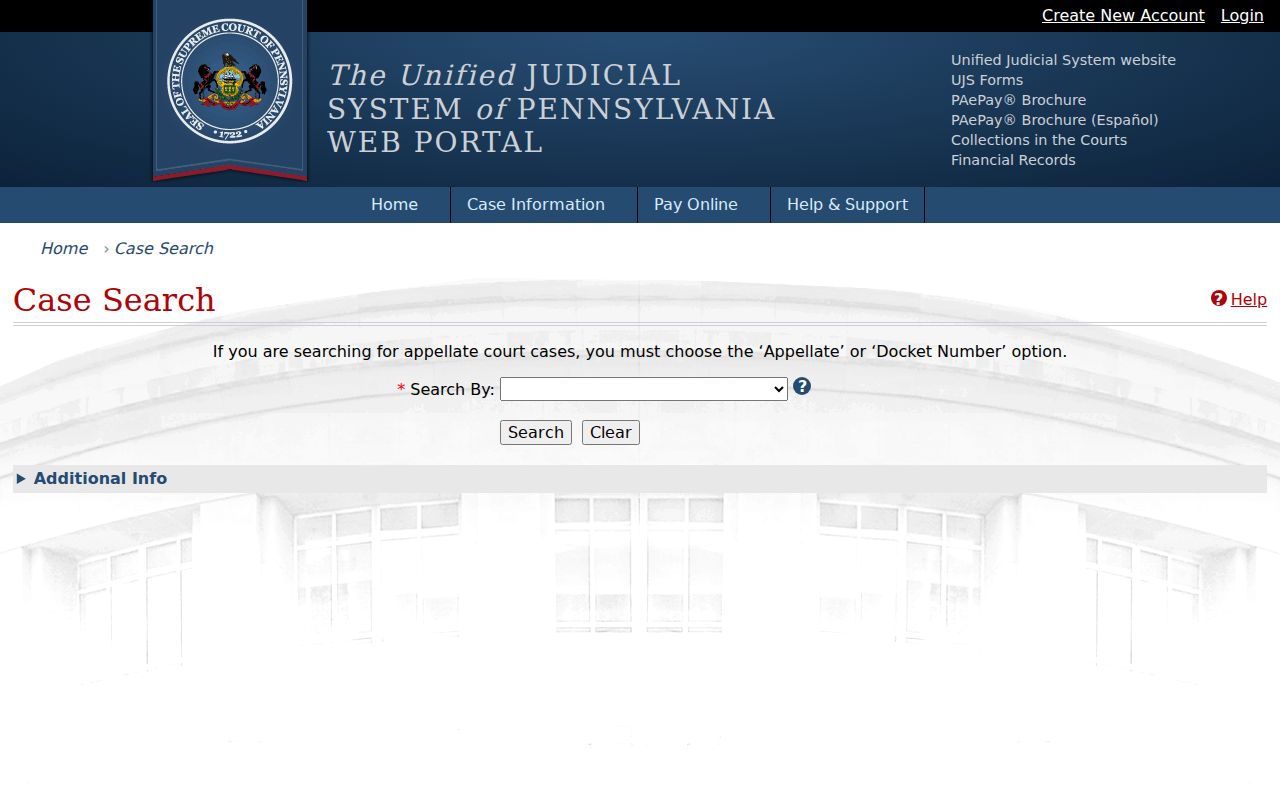
Save the resulting docket number, court, filed date, status, and the spelling searched. Then request a particular document from the named custodian when a certified or fuller court record is needed. The Montgomery County Clerk of Courts holds criminal Court of Common Pleas records at 2 E. Airy Street and can supply certified records subject to sealing and privacy restrictions.
Note: UJS entries can lag court activity, and a docket result is not a certified history or proof that a similarly named person is the subject.
Norristown UJS Docket Details
A public docket sheet is useful because it keeps case facts together. The inspected UJS docket-sheet structure can show docket number, court and county, caption, case status, filing date, case or charge information, participants, counsel, bail, events, and docket entries. A public screen may not expose every item for every case. Secure access and retention rules can also change what is available. Treat the docket as an index to a file, not as a complete account.
| Result item | Safe use in a verification |
|---|---|
| Docket number and court | Identify the proper custodian and the requested file. |
| Filed date and status | Keep the result tied to a stated time period. |
| Participant and counsel fields | Compare name spelling and role, without merging people on a name alone. |
| Events and docket entries | Decide whether a particular dated document is needed. |
The county's docket-search routes also separate criminal, civil, marriage, probate, and Orphans' Court paths. Civil matters go through the Prothonotary's Civil Viewer and document-request process. Estate matters follow the Register of Wills path. Keeping those routes separate prevents a court search from becoming vague or misleading.
Verifying a Norristown Resident
To look up a resident responsibly, anchor the name to a source that has a date and a defined role. An assessment card can supply a situs and parcel identifier, but it separates property location from an assessment mailing address. A recorded deed can supply grantor, grantee, book or page, and recording date, but does not show everyday occupancy. Use those differences as checks, not as gaps to fill with guesses.
- Enter the exact street address and Municipality = NORRISTOWN in the County Address Search, then save the parcel identifier and the displayed municipality.
- Compare the card's last-sale fields with an indexed Recorder instrument, keeping execution and recording dates distinct.
- Search UJS only for a dated court question, narrowing a participant name with Montgomery County and the available docket details.
- Request a defined document from its custodian using the parcel, docket, file, or instrument number rather than asking an office to identify a person.
- Docket
- A court's numbered case record and event index, not a certified account of every fact about a person.
- Index and image
- An index identifies a record. An image is the underlying document and can have separate access, fee, or redaction rules.
- Certified copy
- A custodian-issued copy with certification. It is different from an informational screen or ordinary copy.
- Situs
- The property location shown in a parcel record. It can differ from an assessment mailing address.
When the goal changes from one person to the physical history of a known address, the Norristown Street Directory follows the county's address and parcel trail in more detail.
Norristown Vital Record Paths
Vital records do not supply a general name-to-address lookup. Pennsylvania's Division of Vital Records issues birth and death certificates from 1906 forward through approved online, mail, and in-person channels. A current certificate follows eligibility, identity, and payment rules. Birth records become public 105 years after birth, while death records become public after 50 years. The PHMC archive route for mature records is therefore different from a request for a current certified certificate.
The Pennsylvania birth-certificate page explains the official ordering and eligibility path.
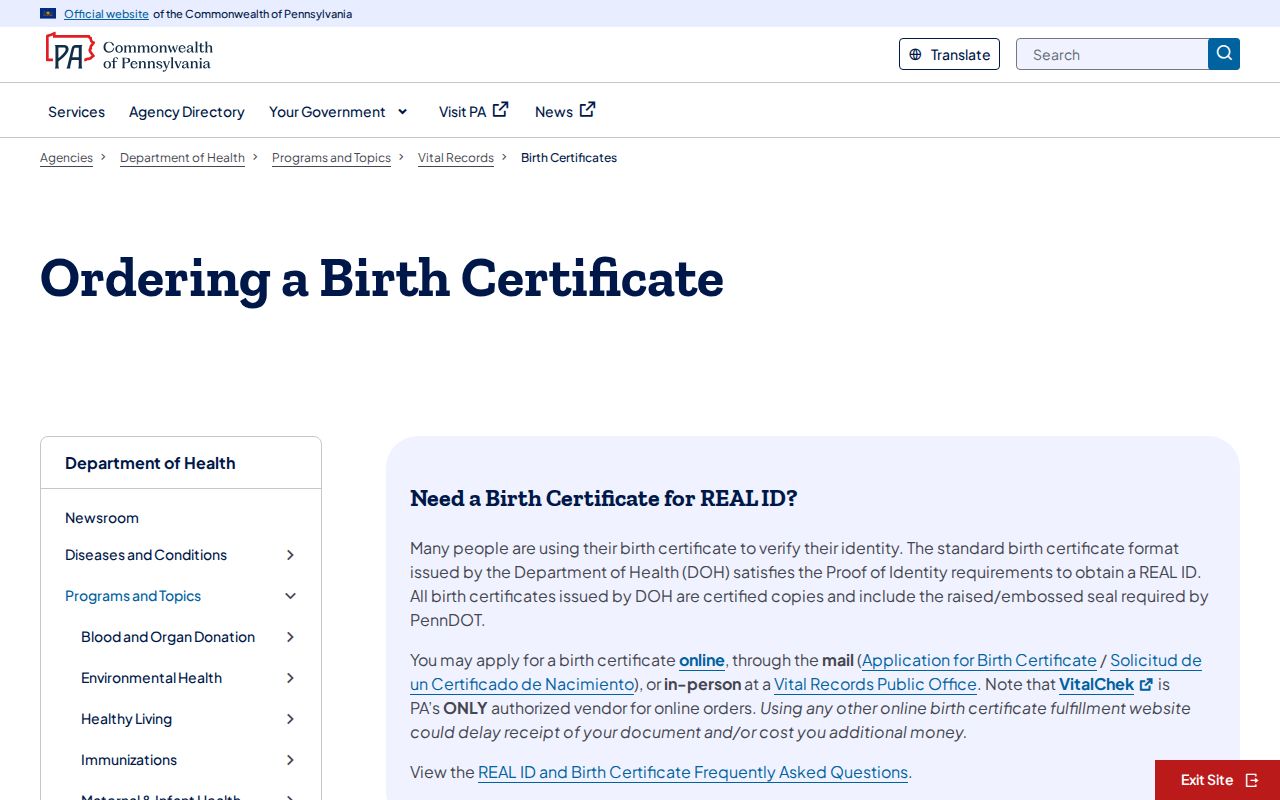
For historical work, PHMC holds birth originals for 1906 through 1920 and death originals for 1906 through 1975. The county Register of Wills identifies Montgomery County birth and death material for 1893 through 1915, but the research did not verify public online search fields for that local series. Contact the office or archives instead of assuming a web search exists.
Pennsylvania's consent-based Adoption Information Registry, PAIR, is not a public search. A birth-parent inquiry belongs only in that authorized registry process. Obituary and cemetery material can provide a dated family-history lead, but needs corroboration from a primary record.
Norristown Estate Record Leads
An estate file can connect a decedent, personal representative, and a dated county proceeding. The Montgomery County Register of Wills and Clerk of Orphans' Court is the proper route for probate, wills, estate filings, marriage licenses, and related proceedings. Its genealogy information identifies probate docket books from 1784 through 1987 and computerized probate beginning in 1988. That is a source-specific change, not a reason to infer missing information about an estate.
Marriage licenses issued by Montgomery County run from 1885 to the present. The official request form asks for both names as used at application, the marriage date, a file number if known, requester information, the number of copies, payment, and a stamped return envelope. It directs pre-1885 research toward church sources or Philadelphia Archives. A dated marriage or probate record can corroborate an event, but it does not establish a person's current address.
Norristown Custody System Scope
Custody and registry systems have narrow public-safety purposes. They are not address tools and should not be used as an address-finding shortcut. The Pennsylvania Department of Corrections locator covers people under state jurisdiction or supervision. Its fields include first, middle, and last name, inmate or parole number, gender, committing county, current location, citizenship, date of birth or approximate age, and sort controls. It updates daily, yet a result does not establish a current home address.
The Pennsylvania Inmate and Department Supervised Individual Locator shows the state-controlled search options.
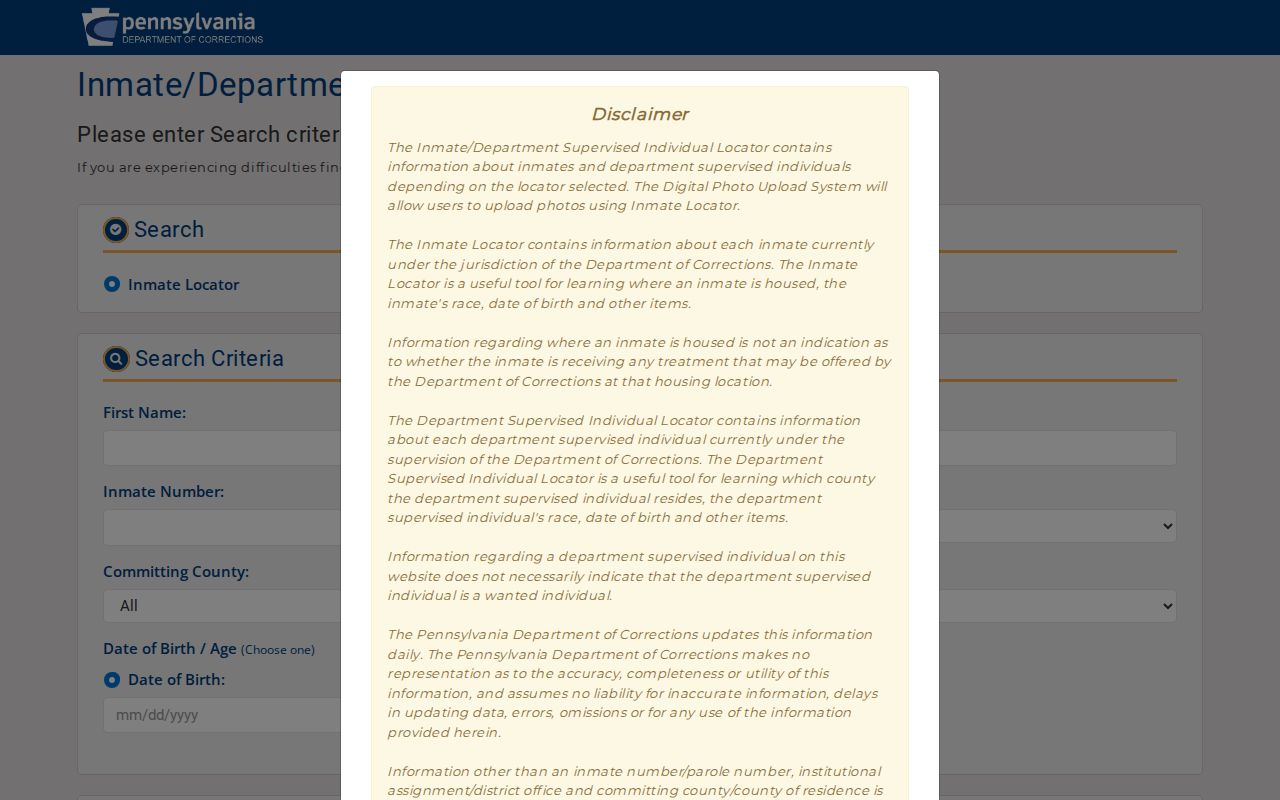
Montgomery County's Correctional Facility page provides contact information, but no official live county roster was located. The state locator must not be presented as a county-jail search. Federal custody is a separate BOP system. A missing hit in any one system does not settle another system's custody status.
The official Pennsylvania Megan's Law search carries its own public-protection conditions and misuse warning.
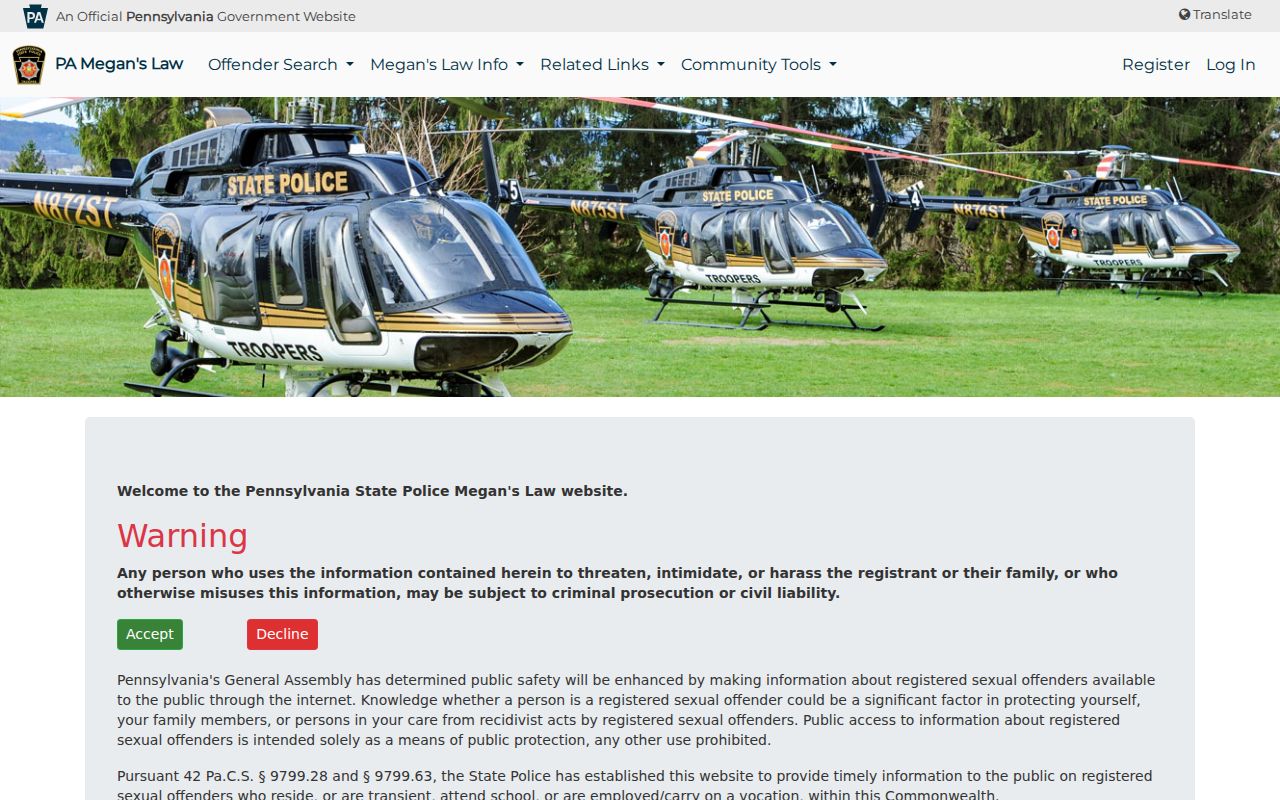
Registry information may be outdated or inaccurate, and fingerprints are the only positive identity method stated in the official FAQ. Threatening, intimidating, harassing, or otherwise unlawful use can create criminal or civil liability. Use the registry only within its statutory public-safety scope.
Norristown Records Request Paths
When no public index answers a specific records question, ask the custodian for an existing, identifiable record. Pennsylvania's Right-to-Know Law applies to executive-agency records, not automatically to court files. The Office of Open Records says an agency normally has five business days to answer or send a lawful extension notice. A qualifying extension can reach no more than 30 calendar days after the original period unless the requester agrees otherwise. Appeals ordinarily go to the Office of Open Records within 15 business days of the response mailing date.
Norristown's own Right-to-Know form supports mail, email, fax, in-person, inspection, and copy choices. State the address, record class, date range, and preferred format. Ask for an existing permit, code file, or other defined document. Do not ask the borough to decide who lived at an address or to create a new list. Court files follow the judiciary's public-access policy and are best requested by docket number and document title.
Norristown Record Access Limits
Pennsylvania law protects many categories that do not belong in a personal record trail, including confidential identification information, personal financial details, medical information, minor information, and many protected addresses. The Address Confidentiality Program gives eligible participants a substitute address for listed state and court records, vehicle records, voter registration, school records, marriage licenses, and utility bills. Never try to replace a listed substitute address with an inferred parcel, court, or mailing address.
Save a source date, query basis, record date, and the limitation that came with each result. Do not merge people solely because their names match. A compatible date plus an independent address, case or instrument number, or family relationship from a primary source is a better minimum check. If a record is redacted or denied, respect that boundary rather than trying to reconstruct it from scattered data.